

Selling commercial real estate in Detroit fast requires understanding the city’s unique market dynamics, connecting with qualified cash buyers who specialize in Detroit properties, and leveraging the momentum of one of America’s most remarkable urban comeback stories. Detroit’s commercial real estate market in 2026 continues attracting investors from across the country drawn by affordable entry points, strong rental demand, ongoing neighborhood revitalization, and appreciation potential that significantly outpaces most major U.S. markets.
Cash buyers for apartment buildings in Detroit represent a particularly active segment of the investment community, with local property management companies expanding portfolios, out-of-state investors capitalizing on Detroit’s transformation, and institutional capital flowing into multifamily properties throughout Metro Detroit. Whether you own a small 6-unit apartment building in the suburbs, a mid-sized 25-unit complex in an emerging neighborhood, or a large 100-unit property in Downtown or Midtown, qualified cash buyers stand ready to make competitive offers and close quickly on your preferred timeline.
Understanding the value of apartment complexes in Detroit empowers property owners to make informed selling decisions, recognize when market conditions favor immediate sales, and negotiate effectively with potential buyers. Detroit’s multifamily market has matured significantly since the city’s recovery began, with professional valuation methodologies, transparent market data, and sophisticated buyer analysis replacing the uncertainty of earlier years. This guide provides comprehensive insights into selling commercial real estate in Detroit fast, identifying cash buyers for apartment buildings, and accurately determining apartment complex values in today’s market.
Why Detroit Commercial Real Estate Sells Fast in 2026
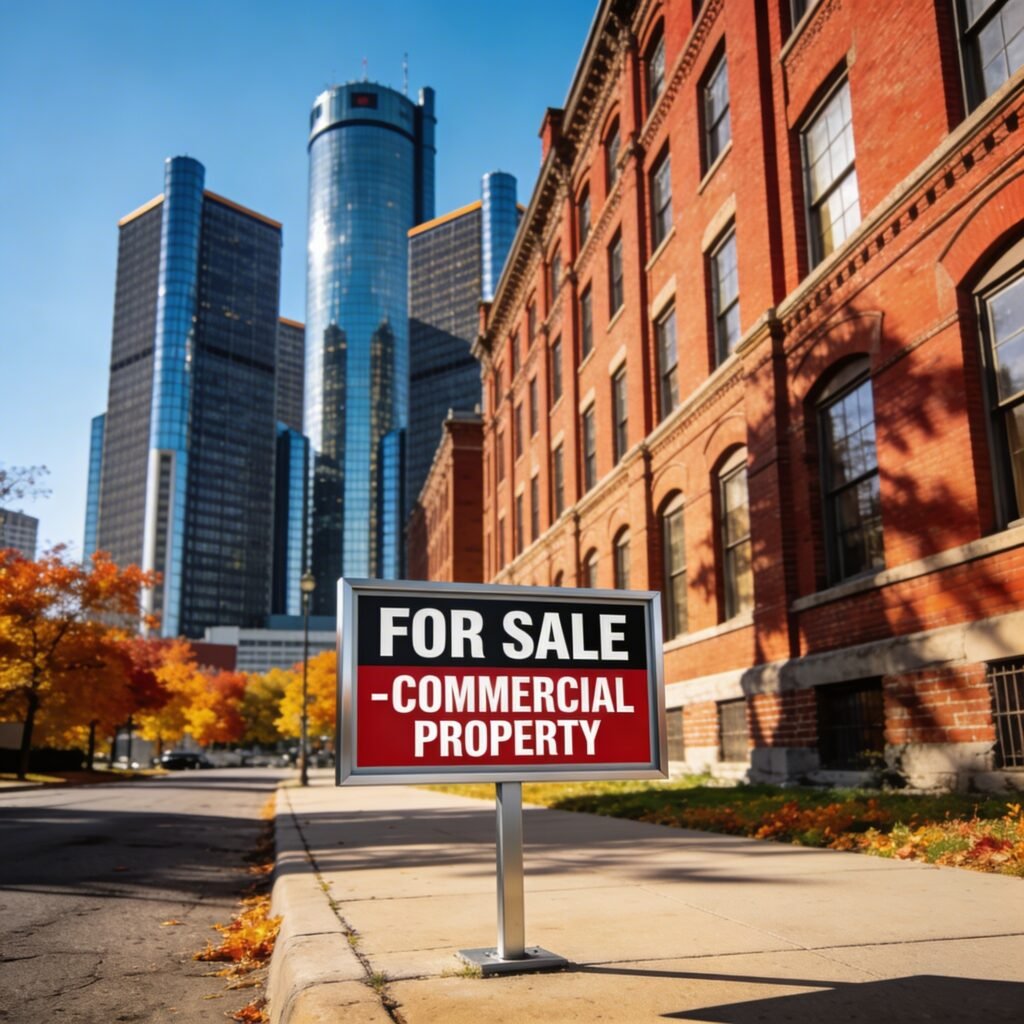
Detroit’s commercial real estate market momentum continues building in 2026, creating conditions that facilitate faster property sales than most U.S. markets. Strong buyer demand from multiple investor categories ensures properties receive quick attention when priced realistically and marketed appropriately. Local Detroit investors who understand neighborhood dynamics and see long-term appreciation potential, out-of-state buyers attracted by affordable pricing relative to coastal markets, institutional investors committing capital to Detroit’s continued growth story, 1031 exchange buyers seeking replacement properties in appreciating markets, and international investors diversifying portfolios into resilient Midwest markets all actively seek Detroit commercial properties.
This diverse buyer pool means commercial properties in desirable locations rarely sit on the market long, with well-priced assets receiving multiple offers within weeks of listing. Downtown Detroit, Midtown, Corktown, Eastern Market, New Center, and select suburban markets like Royal Oak, Ferndale, and Dearborn see particularly strong buyer competition for quality properties. Even properties requiring renovation attract value-add buyers who recognize Detroit’s appreciation trajectory and profitable repositioning opportunities.
Favorable pricing compared to gateway cities makes Detroit commercial real estate accessible to broader buyer segments. While prime office buildings in San Francisco or New York trade at $800 to $1,200 per square foot, comparable Detroit properties trade at $150 to $300 per square foot. Apartment buildings costing $300,000 to $500,000 per unit in Los Angeles or Seattle can be acquired in Detroit for $80,000 to $150,000 per unit in strong neighborhoods. This affordability attracts buyers with limited capital, first-time commercial investors, and experienced operators seeking better returns on invested capital than expensive coastal markets provide.
Improving market fundamentals support buyer confidence and transaction velocity. Detroit’s downtown office occupancy exceeds 90% in Class A buildings near Quicken Loans, General Motors, and other major employers. Residential population in greater downtown has grown from approximately 7,500 in 2010 to over 30,000 in 2026, creating sustained rental demand for multifamily properties. Retail and hospitality sectors benefit from growing tourism with major developments like the Hudson’s Site, renovated Michigan Central Station, and expanded entertainment districts attracting visitors. These positive trends give buyers confidence that Detroit properties will appreciate and perform, accelerating their decision-making and due diligence processes.
Streamlined municipal processes compared to Detroit’s past facilitate faster closings. The city’s improved permit processes, responsive departments, and clear zoning procedures allow buyers to quickly assess development potential and obtain necessary approvals. Title work that once took months due to tax foreclosure complications now processes efficiently through improved Land Bank procedures and clearer ownership records. These operational improvements compress transaction timelines that previously delayed Detroit commercial sales.

Cash Buyers for Apartment Buildings in Detroit Metro
Identifying qualified cash buyers for apartment buildings in Detroit begins with understanding buyer categories and their investment criteria. Local property management companies including Continental Management and other established Detroit firms actively acquire multifamily properties to expand portfolios and capture management fees. These buyers prefer stabilized properties with current tenants, reliable income streams, and minimal immediate capital needs. They typically purchase 10 to 50-unit buildings in established neighborhoods, pay 85% to 95% of market value, and close within 30 to 45 days using conventional financing or cash reserves.
Out-of-state investment companies represent significant buyer pools seeking Detroit’s value opportunities and appreciation potential. Buyers from California, New York, Florida, and Texas regularly acquire Detroit apartment buildings, attracted by cap rates 2% to 4% higher than their home markets, purchase prices 50% to 70% below comparable coastal properties, and strong rental demand supporting stable cash flow. These buyers focus on both stabilized and value-add properties, often have cash available for quick closings, and rely on local property management companies for operations. They typically invest $500,000 to $5,000,000 per acquisition, targeting properties with clear renovation paths and exit strategies.
Private equity firms and family offices allocate increasing capital to Detroit multifamily opportunities as the city’s turnaround gains institutional credibility. These sophisticated buyers acquire larger properties from 50 to 200+ units, prefer Downtown, Midtown, and prime suburban locations, bring significant renovation capital for value-add strategies, and hold properties long-term for income and appreciation. They pay competitive prices at 90% to 95% of market value for quality assets, conduct thorough due diligence, and close within 45 to 60 days. Their presence indicates Detroit’s maturation into an institutional-quality market.
Direct buyers and investment companies like I Sell Commercial Assets purchase apartment buildings of all sizes throughout Metro Detroit without property type or location restrictions. We buy small 5 to 10-unit buildings in emerging neighborhoods, mid-sized 15 to 40-unit properties in established areas, large 50 to 100+ unit complexes in prime locations, and distressed properties requiring major renovation regardless of condition. Our acquisition criteria are flexible, focusing on properties where sellers need fast closings, discrete transactions, or as-is sales without repair requirements. We close in 7 to 14 days when needed, purchase properties with problem tenants or deferred maintenance, and provide certainty through non-contingent cash offers.
1031 exchange buyers continually seek Detroit apartment buildings as replacement properties for concluded sales elsewhere. These buyers face strict IRS deadlines requiring property identification within 45 days and closing within 180 days of selling relinquished properties. This urgency makes them excellent prospects for sellers needing fast closings, often willing to pay premium prices for properties matching their capital requirements and investment objectives. Working with qualified intermediaries administering 1031 exchanges connects sellers with motivated buyers who have immediate capital and compressed timelines.
How to Determine the Value of apartment complexes in Detroit
Professional valuation of Detroit apartment complexes uses the Income Capitalization Approach as the primary methodology, calculating value based on a property’s ability to generate income. The basic formula divides annual Net Operating Income (NOI) by the market Capitalization Rate (cap rate) appropriate for your property type and location. For example, if your 20-unit Detroit apartment building generates $180,000 in annual NOI and comparable properties in your neighborhood trade at an 8.5% cap rate, your estimated value would be $180,000 ÷ 0.085 = $2,117,647.
Calculating accurate Net Operating Income requires detailed financial analysis starting with gross potential rental income based on market rents for all units regardless of current occupancy or lease rates. Detroit market rents in 2026 vary dramatically by location, with Downtown studios ranging from $1,200 to $1,800 monthly, Midtown one-bedrooms at $1,100 to $1,600, Corktown two-bedrooms at $1,400 to $2,200, and suburban units generally 20% to 40% below urban core rates. Multiply market rent per unit by total units and 12 months to calculate gross potential income.
Subtract vacancy and collection losses typically ranging from 5% to 15% based on location and property quality. Prime Downtown locations maintain 5% to 8% vacancy while emerging neighborhoods may experience 10% to 15% vacancy. Also subtract operating expenses including property taxes (often Detroit’s highest expense category at 20% to 30% of gross income), insurance (increasing in recent years to 8% to 12% of income), utilities paid by owner rather than tenants, routine maintenance and repairs, property management fees (typically 8% to 12% of collected rents), landscaping and snow removal, advertising and turnover costs, and legal and professional fees. Detroit properties typically operate at 45% to 60% expense ratios, meaning $100,000 in income results in $45,000 to $60,000 in expenses and $40,000 to $55,000 in NOI.
Selecting appropriate capitalization rates requires analyzing comparable apartment building sales in your Detroit submarket. Downtown and Midtown properties with stabilized occupancy trade at 6.5% to 8% cap rates reflecting low perceived risk and strong demand. Emerging neighborhoods like Corktown, Eastern Market, and New Center trade at 8% to 9.5% cap rates. Established suburban markets trade at 7.5% to 9% cap rates. Secondary Detroit neighborhoods and properties requiring significant work trade at 9% to 12% cap rates accounting for higher risk and necessary capital investment. Research recent sales on LoopNet, CoStar, or through local commercial brokers to identify market cap rates for properties similar to yours.
The Sales Comparison Approach provides additional valuation perspective by analyzing recent comparable sales adjusted for differences in size, condition, location, and other characteristics. Detroit apartment buildings in 2026 show wide per-unit value ranges: Downtown/Midtown renovated properties at $120,000 to $200,000 per unit, Corktown and emerging areas at $80,000 to $140,000 per unit, established suburban locations at $60,000 to $120,000 per unit, and value-add opportunities requiring work at $30,000 to $70,000 per unit. Find three to five comparable sales within the past 12 months, preferably within one mile of your property, and adjust their sale prices for differences to estimate your property’s value range.
Property-specific factors affecting value include unit mix with larger two and three-bedroom units commanding premium values, parking availability with Detroit buyers preferring properties offering one parking space per unit, property condition and age with recently renovated buildings receiving significant premiums, mechanical systems age and remaining useful life, tenant quality and lease terms with credit tenants on long-term leases reducing risk, and neighborhood trajectory with properties in rapidly appreciating areas justifying optimistic valuations. Combine income and sales comparison approaches to triangulate your realistic market value, then adjust for unique characteristics or current market momentum.

Detroit Commercial Real Estate Market Overview 2026
Detroit’s commercial real estate market in 2026 reflects the city’s continued transformation from its bankruptcy era to one of America’s most dynamic urban revitalization success stories. The office market shows bifurcated performance with Class A buildings in Downtown’s central business district maintaining 88% to 94% occupancy driven by Quicken Loans (now Rocket Companies), General Motors, Bedrock Real Estate, Blue Cross Blue Shield, and expanding technology companies. These prime buildings command $28 to $38 per square foot in annual rents with values ranging from $180 to $280 per square foot. Midtown office properties near Wayne State University and healthcare corridors maintain 80% to 88% occupancy at $22 to $32 per square foot rents.
Suburban Detroit office markets face headwinds from remote work trends and aging inventory. Southfield’s office corridor along Northwestern Highway, Troy’s Big Beaver Road area, and Dearborn’s Fairlane area experience 70% to 80% occupancy with rents at $18 to $26 per square foot and limited new lease activity. However, these markets provide value-add opportunities for buyers willing to renovate and reposition buildings for modern tenant requirements emphasizing amenitized, flexible spaces with strong technology infrastructure.
The retail sector demonstrates resilience in well-located properties with experiential tenants. Downtown Detroit retail spaces along Woodward Avenue, in Campus Martius, and within new developments command $35 to $60 per square foot annually. Midtown retail near restaurants and entertainment venues maintains $25 to $45 per square foot rents. Suburban neighborhood centers anchored by grocery stores, pharmacies, or fitness concepts perform steadily at $18 to $28 per square foot. Struggling strip centers and enclosed malls continue facing pressure, though some present redevelopment opportunities for mixed-use or alternative uses.
Industrial properties throughout Metro Detroit maintain exceptional strength driven by automotive supply chain proximity, e-commerce distribution needs, and manufacturing reshoring trends. Modern warehouses with 28-foot to 36-foot clear heights, superior truck access, and proximity to I-75, I-94, I-96, or Metro Airport command $6 to $9 per square foot in annual rents with values at $70 to $95 per square foot. Older industrial buildings with lower ceilings trade at $4 to $6 per square foot rents and $40 to $60 per square foot values but present conversion opportunities for creative office, brewery/restaurant uses, or light manufacturing.
Fastest Ways to Sell Commercial Property in Detroit
Selling to cash buyers eliminates financing contingencies that cause 25% to 35% of traditional Detroit commercial sales to collapse. Cash buyers like I Sell Commercial Assets make offers within 72 hours of property inspection, proceed to closing within 7 to 14 days for urgent situations or 21 to 30 days for standard transactions, purchase properties as-is without repair requirements, and provide certainty through non-contingent contracts backed by proof of funds. While cash offers typically range from 75% to 90% of retail value, the combination of speed, certainty, eliminated commission fees (saving 6% to 10%), avoided repair costs, and 6 to 12 months of saved holding expenses often produces net proceeds equal to or exceeding traditional sales.
Pricing competitively attracts immediate buyer attention and generates multiple offers creating competitive dynamics. Research comparable Detroit sales within your submarket from the past 6 to 12 months, analyze current listings competing for similar buyer pools, calculate realistic values using income capitalization and sales comparison approaches, and set asking prices at 95% to 100% of calculated market value rather than inflated hopes that extend marketing periods. Aggressively priced Detroit properties receive showings within days, offers within two to three weeks, and often close above asking prices when multiple buyers compete.
Professional marketing reaches qualified buyers quickly through LoopNet premium listings showcasing properties to thousands of active Detroit investors, CoStar listings if you have broker access, targeted email campaigns to local investment groups and property management companies, networking through Detroit Real Estate Investors Association and similar organizations, LinkedIn outreach to commercial brokers and investors focused on Detroit, and direct contact with known apartment building buyers like those discussed earlier. High-quality photography, detailed financial information, neighborhood context about revitalization trends, and clear value propositions separate professional listings from ***** attempts.
Offering flexible terms accommodates different buyer types and situations. Seller financing for 20% to 30% of purchase prices attracts buyers with limited capital or those struggling with traditional bank financing. Quick closing schedules appeal to 1031 exchange buyers and cash purchasers seeking immediate acquisitions. Extended due diligence periods help less experienced buyers or those requiring complex financing. Leaseback arrangements allowing you to remain as a tenant temporarily can facilitate sales when you need property proceeds before relocating operations. Flexibility often means the difference between closing deals or losing buyers to competing properties offering better terms.
Get A Listing Offer
Detroit Multifamily Property Values and Cap Rates 2026
Downtown Detroit multifamily values reflect the area’s transformation into a live-work-play urban center. Properties within the greater downtown area including the central business district, Capitol Park, Brush Park, and adjacent neighborhoods command premium values driven by proximity to major employers, walkability to restaurants and entertainment, and limited new supply despite strong demand. Renovated apartment buildings in these prime locations trade at $140,000 to $200,000 per unit with cap rates at 6% to 7.5%. Partially renovated buildings requiring some unit upgrades trade at $100,000 to $140,000 per unit with 7.5% to 8.5% cap rates. Value-add properties needing comprehensive renovations trade at $60,000 to $100,000 per unit with 9% to 11% cap rates.
Midtown Detroit near Wayne State University, Detroit Medical Center, and the Cultural Center maintains strong multifamily fundamentals supported by students, medical professionals, and young professionals working nearby. Properties trade at $110,000 to $180,000 per unit for renovated buildings with 7% to 8.5% cap rates. Student-oriented properties with studio and one-bedroom units dominate, though larger units attract healthcare workers and families. The area’s institutional anchors provide stability and consistent rental demand supporting property values.
Corktown, Detroit’s oldest neighborhood undergoing dramatic revitalization accelerated by Ford Motor Company’s redevelopment of Michigan Central Station, has become one of Detroit’s hottest apartment markets. Renovated multifamily properties trade at $100,000 to $180,000 per unit with 7.5% to 9% cap rates. The neighborhood’s walkability, emerging restaurant scene, proximity to downtown, and ongoing investment momentum attract younger renters willing to pay premium rents. Properties requiring renovation trade at $60,000 to $100,000 per unit offering substantial value-add potential.
Established Detroit neighborhoods including Palmer Woods, Indian Village, Boston-Edison, and others feature historic apartment buildings and smaller multifamily properties. These areas maintain stable values at $50,000 to $90,000 per unit with 8% to 10% cap rates depending on property condition and specific micro-location. While not experiencing the appreciation of downtown areas, these neighborhoods provide steady income and lower acquisition costs attracting value-oriented investors.
Suburban Metro Detroit multifamily markets in cities like Dearborn, Royal Oak, Ferndale, Southfield, and Sterling Heights offer diverse investment opportunities. Class A suburban properties in walkable downtown areas command $90,000 to $140,000 per unit with 6.5% to 8% cap rates. Class B properties in residential neighborhoods trade at $60,000 to $100,000 per unit with 8% to 9.5% cap rates. These suburban markets provide stable cash flow with moderate appreciation, attracting investors seeking lower risk profiles than urban core properties.
Ready to sell your commercial real estate in Detroit fast? I Sell Commercial Assets is the leading cash buyer for Detroit apartment buildings, office properties, retail centers, and all commercial real estate throughout Metro Detroit. We provide fair cash offers within 72 hours, close in 7 to 14 days when you need speed, purchase properties in any condition without repair requirements, and maintain complete confidentiality throughout the transaction. Whether you own a small apartment building in the suburbs, a mid-sized multifamily property in an emerging neighborhood, or a large complex in Downtown or Midtown, we have the capital, experience, and local market knowledge to close your deal quickly and professionally. Contact us today for your free, no-obligation cash offer and discover why Detroit property owners choose us when they need to sell commercial real estate in Detroit fast.