



Sell Multifamily in Ann Arbor
Ann Arbor, MI stands as a distinct outlier in the Midwest real estate landscape. Anchored by the University of Michigan and a burgeoning tech sector, the local multifamily market is demonstrating remarkable resilience against broader economic headwinds. For investors, the 2024-2025 data paints a clear picture: in this “Education Economy,” stability is the premium asset.
- Market Fundamentals Remain Exceptionally Tight
- Strong Pricing and Stable Cap Rates Support Valuations
- Buyer Demand Is Diversifying and Becoming More Strategic
- Value-Add Priorities Are Shifting Toward Infrastructure and Convenience
A Quick Update on the Ann Arbor Multifamily Market – 2025
The Hard Numbers
While many national markets are experiencing softening fundamentals, Ann Arbor’s multifamily market remains exceptionally tight. Vacancy rates are holding at historic lows of 2.4%, supporting steady annual rent growth of approximately 4.8%. As a result, property valuations remain strong, with average pricing reaching $215,000 per unit and cap rates stabilizing near 5.8%.
What Buyers Are Looking For
Buyer demand in Ann Arbor is becoming more diverse. Local private investors continue to account for roughly 45% of transactions, while more than one-third of investment capital is now coming from out-of-state buyers seeking reliable, recession-resistant yield.
Shifting Priorities in Value-Add Properties
Within these value-add submarkets, buyer priorities have changed. Tenants are placing greater emphasis on connectivity and convenience, and are increasingly willing to pay rent premiums for these features.
Evolving Investment Strategy
At the same time, investment strategy is evolving. The traditional “buy and hold” approach is shifting toward “buy and optimize.” Investors are increasingly targeting opportunities outside the high-priced downtown core, including Kerrytown and the Old West Side, in favor of more attractive entry points within a 2–3 mile radius, such as the Packard and Platt corridors.
Digital Infrastructure & Tenant Demand
High-speed fiber internet and in-unit laundry have emerged as the strongest drivers of rental upside, often delivering higher returns than purely cosmetic renovations. In 2025, digital infrastructure is just as important as physical location when it comes to maximizing asset performance.

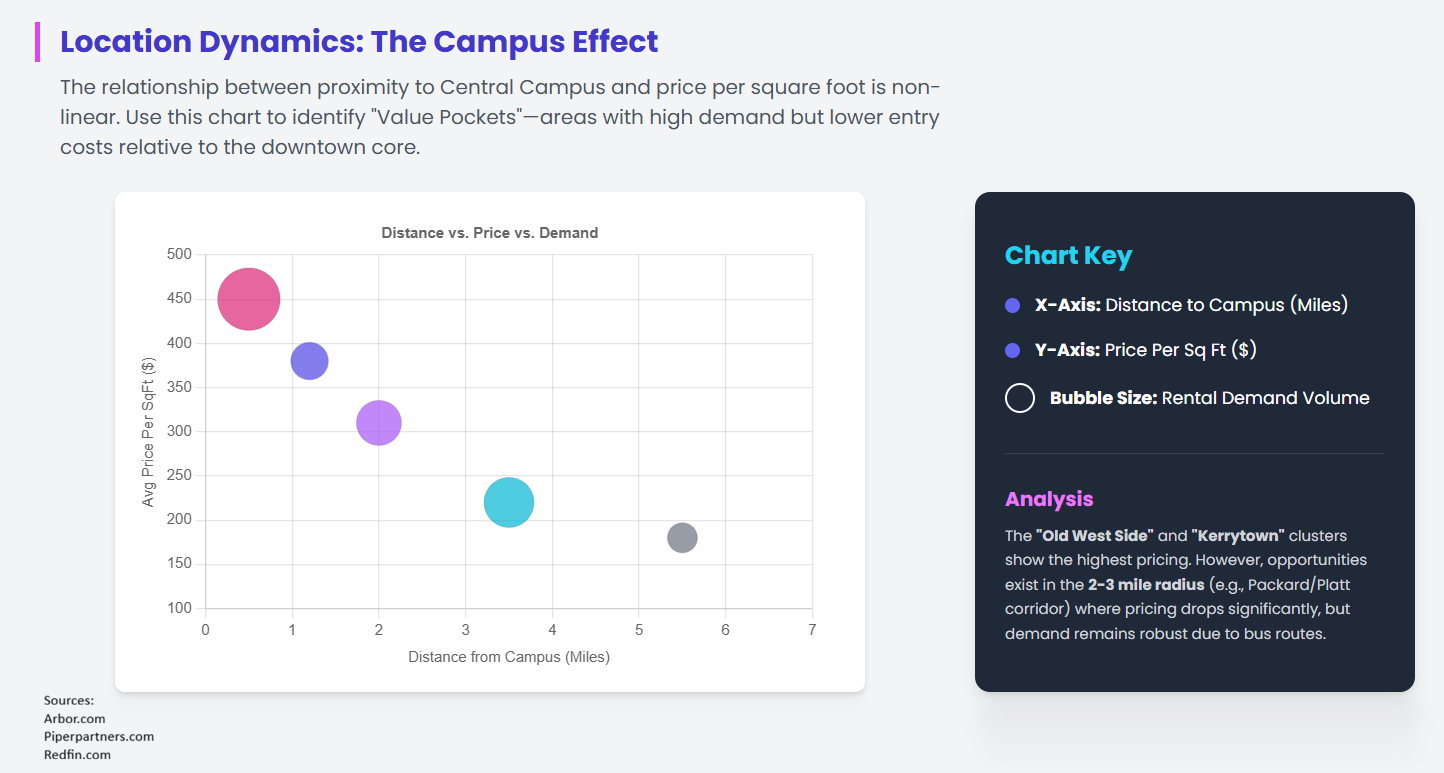
How Campus Proximity Drives Multifamily Value
Maximizing Multifamily Value in Ann Arbor’s Tight Market
Many multifamily owners in Ann Arbor focus solely on long-term holding without fully capitalizing on today’s unusually strong market conditions. Sophisticated investors take a more strategic approach—prioritizing timing, operational efficiency, and buyer demand to maximize value while market fundamentals remain exceptionally favorable.
- Sell Into Peak Market Strength – With vacancy rates at historic lows and rent growth nearing 5%, Ann Arbor is firmly in a seller-advantaged position. Listing while buyer competition remains strong allows owners to capture premium pricing before new supply, interest-rate shifts, or economic headwinds soften demand.
- Position Assets for Buyer Priorities – Today’s buyers are underwriting operational performance, not just location. Properties that demonstrate stable occupancy, clean financials, and proven rent growth command stronger offers and faster closings. Clear expense controls and documented upside potential significantly increase buyer confidence.
- Optimize Before You Exit – The strategy has shifted from “buy and hold” to “buy and optimize.” Targeted improvements—such as in-unit laundry, high-speed fiber internet, or operational efficiencies—often deliver outsized returns at sale, outperforming cosmetic upgrades that do not materially impact NOI.